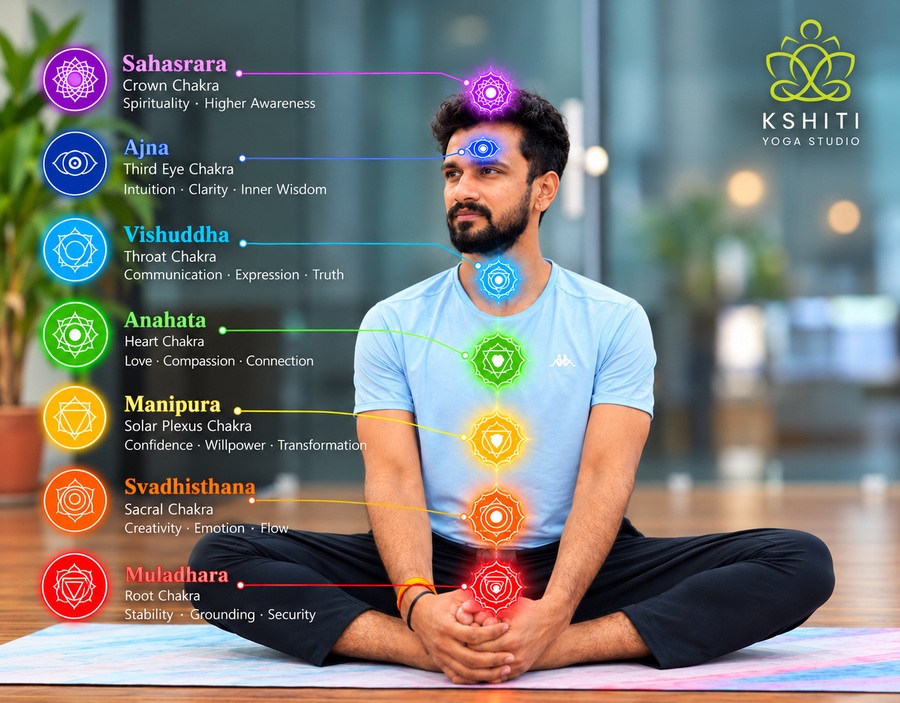
The Seven Chakras Explained: Meaning, Locations, Colours and Yoga Practices
Explore the seven chakras in traditional yoga philosophy, their symbolic meanings, locations, elements, seed mantras, and the role of yoga and meditation in self-awareness.
Have you ever wondered why yoga is considered more than a physical practice? Beyond improving flexibility, strength, and balance, yoga offers a philosophical framework for exploring the relationship between the body, breath, mind, and consciousness.
One important part of this framework is the chakra system.
In traditional yogic philosophy, chakras are described as subtle centres associated with prana, the vital life force, and different dimensions of awareness. The Sanskrit word chakra means wheel or circle. These centres feature prominently in several yogic and Tantric traditions, particularly those concerned with meditation and Kundalini Yoga.
The familiar seven-chakra system provides a way to explore different aspects of the human experience, including stability, emotional awareness, personal discipline, compassion, communication, concentration, and spiritual development.
Understanding the chakras can add depth to your yoga practice by encouraging you to look beyond physical postures and explore the mental and contemplative dimensions of yoga.
At Kshiti Yoga Studio in Bhopal, we believe yoga is a journey of movement, mindfulness, and self-discovery. Learning about chakra philosophy can help practitioners appreciate the broader traditions from which yoga has developed.
In this guide, we explore the seven commonly discussed chakras, their traditional symbolism, and practical ways to incorporate these ideas into yoga and meditation.
What Are Chakras in Yoga?
Chakras are described in traditional yogic philosophy as subtle centres within the human energy system. They are associated with prana, the nadis through which prana is traditionally understood to flow, and the development of awareness.
Unlike organs, muscles, or nerves, chakras are not recognised anatomical structures that can be identified through ordinary physical examination. Their descriptions belong to spiritual and philosophical models developed within particular yoga and Tantric traditions.
To understand chakras, it helps to become familiar with four related concepts.
1. Prana: The Vital Life Force
Prana is a central concept in yoga philosophy. It is traditionally understood as the vital force associated with life and the functioning of the subtle body.
Pranayama practices work with breathing through techniques involving awareness, regulation, and, in some cases, deliberate changes to the breath.
Although breathing has measurable physiological effects, prana as described in traditional subtle-body teachings should not be equated with a scientifically established form of energy.
2. Nadis: The Subtle Channels
Nadis are described in yogic philosophy as subtle pathways through which prana flows.
Three nadis are particularly significant in many Kundalini Yoga traditions:
- Ida Nadi: Traditionally associated with lunar, cooling, and receptive qualities.
- Pingala Nadi: Traditionally associated with solar, warming, and active qualities.
- Sushumna Nadi: The central channel associated with the progression of awareness through the chakra system.
These are traditional subtle-body concepts, not direct equivalents of nerves or blood vessels.
3. Kundalini Shakti: Latent Spiritual Potential
Kundalini Shakti is a traditional spiritual concept associated with latent potential and transformative awareness. In many Kundalini Yoga systems, it is symbolically associated with Muladhara, the Root Chakra.
Practices intended to prepare for Kundalini Yoga may include asana, pranayama, concentration, meditation, and other techniques taught within a particular tradition.
Advanced practices should be approached gradually and with qualified guidance.
4. Koshas: The Dimensions of Human Experience
Some yogic philosophies describe five koshas, or sheaths, through which human experience is understood.
These are traditionally associated with the physical body, vital energy, mental activity, discernment, and bliss.
The koshas offer another philosophical framework for exploring the relationship between the physical and contemplative dimensions of yoga.
Together, chakras, prana, nadis, Kundalini Shakti, and koshas form part of a wider system of traditional yogic thought.
How Many Chakras Are There?
The number and arrangement of chakras differ across traditional yoga and Tantric texts.
The seven-chakra system is widely used in contemporary yoga teaching. It identifies seven principal centres arranged from the base of the spine to the crown of the head.
However, some traditional systems describe six main chakras along the central axis and discuss Sahasrara separately. Certain texts also include Bindu and other subtle centres.
For this article, we will explore the seven commonly discussed chakras:
- Muladhara — Root Chakra
- Svadhisthana — Sacral Chakra
- Manipura — Solar Plexus Chakra
- Anahata — Heart Chakra
- Vishuddha — Throat Chakra
- Ajna — Third Eye Chakra
- Sahasrara — Crown Chakra
Each centre has its own symbolic associations, including a traditional location, an element or principle, lotus imagery, and, in certain systems, a seed mantra.
These associations provide a framework for contemplation rather than a scientifically established map of physical energy centres.
1. Muladhara Chakra: The Root of Stability
Traditional location: Base of the spine, associated with the perineal region
Element: Earth
Symbolic colour: Red
Lotus petals: Four
Seed mantra: Lam
Central theme: Grounding, stability, and security
Muladhara is commonly known as the Root Chakra. Its name is associated with the idea of a foundation or root support.
In traditional yogic philosophy, Muladhara represents the foundation of the subtle-body system and is associated with Kundalini Shakti.
The earth element symbolises solidity, stability, and support. These qualities offer a useful starting point for reflecting on how we experience everyday life.
Do you feel grounded in your daily routine? Can you remain steady when circumstances become uncertain? Are you able to respond to challenges without becoming overwhelmed by every change?
Such questions connect the symbolism of Muladhara with practical self-awareness.
Traditional descriptions also associate this centre with instinctive tendencies and deeply rooted patterns of the unconscious mind.
Yoga practices inspired by Muladhara
Grounding can be explored through postures and practices that encourage awareness of the body's contact with the floor.
Examples include:
- Tadasana (Mountain Pose)
- Vrksasana (Tree Pose)
- Gentle standing yoga sequences
- Malasana (Garland Pose), when suitable
- Body-awareness meditation
- Comfortable, natural breathing
During practice, notice the contact between your feet and the ground, the distribution of your weight, and the steadiness of your posture.
The objective is to cultivate physical awareness and concentration, not to assume that a specific sensation proves that a chakra has opened.
Reflection: What routines, relationships, and habits help you feel grounded in your life?
2. Svadhisthana Chakra: Emotion, Creativity and Adaptability
Traditional location: Lower abdominal or pelvic region
Element: Water
Symbolic colour: Orange
Lotus petals: Six
Seed mantra: Vam
Central theme: Emotional awareness, creativity, and adaptability
Svadhisthana is commonly known as the Sacral Chakra. Its name is traditionally associated with one's own abode or dwelling.
The water element symbolises movement, fluidity, and change. This makes it a meaningful metaphor for exploring emotions and our responses to different experiences.
Human emotions are not static. They change with our circumstances, relationships, memories, and expectations.
Creativity also requires flexibility: the willingness to experiment, learn, and move beyond familiar patterns.
Within traditional chakra symbolism, Svadhisthana is associated with desire, pleasure, sensual experience, and the impressions that influence individual behaviour.
These associations do not mean that every desire is harmful or that difficult emotions indicate a blocked chakra. Instead, the symbolism can encourage us to observe our emotions with greater awareness.
Yoga practices inspired by Svadhisthana
Gentle movement and mindful breathing can help practitioners become more aware of physical sensations and their responses to movement.
Examples include:
- Baddha Konasana (Bound Angle Pose)
- Marjaryasana-Bitilasana (Cat-Cow Pose)
- Gentle pelvic mobility exercises
- Supported Supta Baddha Konasana (Reclining Bound Angle Pose)
- Breath-awareness meditation
- Reflective journaling
Adapt these practices to your mobility and comfort. No particular posture can guarantee emotional release or activate a specific chakra.
Reflection: Can you recognise your emotions without allowing every emotion to determine your actions?
3. Manipura Chakra: Confidence, Discipline and Transformation
Traditional location: Navel region
Element: Fire
Symbolic colour: Yellow
Lotus petals: Ten
Seed mantra: Ram
Central theme: Willpower, confidence, vitality, and purposeful action
Manipura is commonly known as the Solar Plexus Chakra. Its name is often translated as the city of jewels.
In traditional chakra philosophy, Manipura represents transformation and the capacity to direct one's energy towards meaningful action.
Its associated element is fire, a symbol of change, vitality, and transformation.
Consider the difference between having an intention and consistently acting on it.
You may wish to become stronger, develop a regular yoga practice, improve your concentration, or learn a new skill. Yet lasting progress often requires patience and discipline rather than motivation alone.
The symbolism of Manipura offers an opportunity to reflect on these qualities.
Traditional descriptions also connect this centre with prana, vitality, and the concept of agni, or digestive fire. These associations belong to yogic and related traditional frameworks; they should not be interpreted as proof that a chakra controls metabolism or digestive health.
Yoga practices inspired by Manipura
Practices involving strength, balance, and concentration may provide opportunities to explore determination and purposeful effort.
Examples include:
- Phalakasana (Plank Pose)
- Virabhadrasana I and II (Warrior Poses)
- Navasana (Boat Pose), with modifications
- Surya Namaskar (Sun Salutation)
- Mindful movement coordinated with breathing
- Meditation on intentions and personal commitments
Choose variations appropriate to your physical condition and experience.
The goal is not to push through pain or perform the most difficult variation. It is to develop awareness of effort, patience, and consistency.
Reflection: What is one meaningful commitment you can honour consistently, even when motivation changes?
4. Anahata Chakra: Compassion, Connection and Balance
Traditional location: Centre of the chest
Element: Air
Symbolic colour: Green in many contemporary representations
Lotus petals: Twelve
Seed mantra: Yam
Central theme: Compassion, connection, and emotional awareness
Anahata is commonly known as the Heart Chakra.
The Sanskrit term is traditionally associated with the idea of an unstruck sound. Within chakra philosophy, the centre is also connected with compassion, devotion, and the relationship between the individual and others.
The air element symbolises movement, openness, and expansion.
These associations invite us to reflect on how we respond to people, whether we can listen with care, and how we balance compassion for others with respect for ourselves.
Compassion does not require us to agree with everyone or abandon personal boundaries. Instead, it involves recognising the experiences of others while responding thoughtfully.
Yoga practices inspired by Anahata
Practices that encourage comfortable chest movement, shoulder mobility, and breath awareness can help develop greater awareness of the body.
Examples include:
- Bhujangasana (Cobra Pose)
- Setu Bandha Sarvangasana (Bridge Pose)
- Supported Matsyasana (Fish Pose)
- Gentle shoulder-opening movements
- Loving-kindness meditation
- Gratitude practices
Backbends should be modified to suit your mobility and physical needs.
You can also explore the themes of Anahata through everyday actions: listening without immediately judging, expressing gratitude, and offering kindness without expecting something in return.
Reflection: Can you approach yourself and others with compassion while maintaining healthy boundaries?
5. Vishuddha Chakra: Communication, Expression and Clarity
Traditional location: Throat region
Element: Space or ether
Symbolic colour: Blue
Lotus petals: Sixteen
Seed mantra: Ham
Central theme: Communication, listening, and self-expression
Vishuddha is commonly known as the Throat Chakra. Its traditional associations include purification, communication, and subtle sound.
The associated element, akasha, is commonly translated as space or ether.
Within the chakra model, Vishuddha provides a framework for reflecting on the relationship between listening, speaking, and expressing ourselves clearly.
Effective communication involves more than speaking confidently. It also requires patience, honesty, and the willingness to listen.
We can explore this centre by asking ourselves:
- Do I communicate my needs clearly?
- Can I listen without immediately preparing a response?
- Do my words reflect my intentions?
- Can I acknowledge when I am mistaken?
- Do I know when silence is more appropriate than speaking?
These questions connect traditional symbolism with everyday behaviour.
Yoga practices inspired by Vishuddha
Examples include:
- Gentle neck and shoulder movements
- Comfortable upright seated postures
- Bhramari Pranayama (Humming Bee Breath), when appropriate
- Mantra repetition
- Mindful listening
- Meditation on speech and silence
Avoid forcing the breath or creating unnecessary tension in the throat.
Chanting can be practised as a way to focus attention and explore the relationship between breath and sound. It should not be presented as a guaranteed treatment for thyroid disorders or other medical conditions.
Reflection: Do you express yourself honestly while making space to understand others?
6. Ajna Chakra: Concentration, Intuition and Inner Awareness
Traditional location: Eyebrow centre, with deeper associations in the midline of the head
Symbolic colour: Indigo in many contemporary representations
Lotus petals: Two
Seed mantra: Om
Central theme: Concentration, discernment, and self-observation
Ajna is commonly known as the Third Eye Chakra. The Sanskrit term is often translated as command, and the centre is sometimes described as the guru chakra.
In traditional yogic philosophy, Ajna is associated with concentration, meditation, and the development of awareness.
The eyebrow centre, known as bhrumadhya, serves as a focal point in certain meditation practices.
Ajna also provides a useful framework for reflecting on the relationship between thoughts, perceptions, and understanding.
Consider how often we mistake an assumption for a fact or allow past experiences to influence our interpretation of a new situation.
Developing awareness involves recognising these mental patterns and learning to examine them rather than automatically accepting every thought.
Yoga practices inspired by Ajna
Examples include:
- Breath-awareness meditation
- Mantra meditation
- Gentle concentration at the eyebrow centre
- Trataka, or steady gazing, practised safely
- Guided visualisation
- Mindful observation of thoughts
Avoid forcing the eyes upwards or creating tension in the forehead.
Some traditional texts associate Ajna with subtle perception and extraordinary experiences. These accounts belong to spiritual traditions and should not be treated as established evidence of psychic abilities.
Reflection: Can you observe your thoughts without immediately believing or reacting to them?
7. Sahasrara Chakra: Spiritual Awareness and Wholeness
Traditional location: Crown of the head
Symbolic colour: Violet or white in many contemporary representations
Lotus symbolism: A thousand petals
Central theme: Transcendence, unity, and spiritual realisation
Sahasrara is commonly known as the Crown Chakra.
Its name is associated with the thousand-petalled lotus, a symbol of expansive consciousness and spiritual fulfilment.
In some traditional systems, Sahasrara is understood differently from the other chakras. Rather than representing simply another centre along the spine, it is associated with supreme consciousness or the culmination of spiritual practice.
The symbolism invites reflection on our relationship with identity, attachment, and the wider world.
For some practitioners, it represents spiritual unity. For others, it provides a framework for contemplating awareness beyond the constant activity of the mind.
These interpretations vary between traditions and are matters of spiritual philosophy rather than measurable physiological states.
Yoga practices inspired by Sahasrara
Practices may include:
- Silent meditation
- Open-awareness meditation
- Breath-awareness practice
- Contemplation of interconnectedness
- Study of yogic philosophy
- Quiet sitting after pranayama
There is no need to chase unusual sensations or force a particular meditative experience.
A patient approach emphasises consistent practice, self-awareness, ethical conduct, and the ability to bring greater clarity into everyday life.
Reflection: What does living with greater awareness, humility, and a sense of connection mean to you?
Bindu: An Additional Centre in Traditional Yogic Philosophy
Bindu is an important concept in some traditional yoga and Tantric systems, although it is not always included in the commonly taught seven-chakra model.
The Sanskrit word bindu means point or drop.
In certain subtle-body descriptions, Bindu is associated with the upper back portion of the head and symbolises the point from which multiplicity emerges and to which it ultimately returns.
Some traditional teachings associate Bindu with amrita, often translated as nectar, and with the subtle sound known as nada.
These concepts form part of particular spiritual explanations of creation, consciousness, and advanced yogic practice. They should not be interpreted as scientifically established mechanisms for preventing ageing, curing disease, or extending life.
Bindu illustrates an important point: the chakra system is more diverse than the simplified diagrams often seen in contemporary wellness settings.
The Relationship Between Chakras and the Five Koshas
The koshas provide another framework for understanding the different dimensions of human experience in traditional yoga philosophy.
The five koshas are commonly described as follows.
Annamaya Kosha: The Physical Dimension
Annamaya Kosha refers to the physical body, which depends on nourishment and the material conditions of life.
Asana practice encourages awareness of posture, movement, balance, and bodily sensations.
Pranamaya Kosha: The Vital Dimension
Pranamaya Kosha is associated with prana in the traditional subtle-body model.
Breath awareness and pranayama are important practices within this framework.
Manomaya Kosha: The Mental and Emotional Dimension
Manomaya Kosha is associated with mental activity, sensory experience, and emotional responses.
Meditation and mindfulness can help practitioners observe thoughts and reactions more consciously.
Vijnanamaya Kosha: The Wisdom Dimension
Vijnanamaya Kosha is associated with discernment, understanding, and insight.
Reflective study, concentration, and self-inquiry can support the exploration of these qualities.
Anandamaya Kosha: The Bliss Dimension
Anandamaya Kosha is associated with bliss or a subtle dimension of fulfilment in traditional yogic philosophy.
It is explored through contemplative practice and philosophical inquiry rather than a particular physical exercise.
Different texts describe the relationship between the koshas and chakras in different ways. Neither framework should be treated as an established anatomical model.
Together, these concepts offer a philosophical way to reflect on the relationship between physical experience, breathing, mental activity, discernment, and spiritual awareness.
How to Explore the Chakras Through Yoga and Meditation
You do not need to perform advanced postures or experience unusual sensations to begin exploring chakra philosophy.
A balanced practice can include physical movement, comfortable breathing, concentration, meditation, and reflection.
1. Practise Asana Mindfully
Yoga postures can help develop strength, mobility, balance, and body awareness.
Instead of moving mechanically between postures, observe your breathing, alignment, and response to effort.
Standing postures can provide opportunities to explore stability, while seated practices can offer a foundation for meditation.
These are reflective associations rather than evidence that a particular posture activates a specific chakra.
2. Begin With Comfortable Breathing
Pranayama is an important component of many traditional yoga systems.
Start with natural breathing and learn suitable techniques gradually under qualified guidance.
Some breathing practices may help people relax and manage stress, but advanced techniques, forceful breathing, and prolonged breath retention are not appropriate for everyone.
3. Practise Meditation Regularly
Meditation offers an opportunity to observe thoughts, emotions, sensations, and attention.
You may focus on the breath, repeat a mantra, or use a traditional chakra visualisation.
Approach the practice with curiosity rather than expecting a particular sensation or result.
4. Explore Traditional Seed Mantras
Certain chakra systems associate specific seed mantras, or bija mantras, with individual centres.
The commonly taught associations are:
| Chakra | Seed mantra |
|---|---|
| Muladhara | Lam |
| Svadhisthana | Vam |
| Manipura | Ram |
| Anahata | Yam |
| Vishuddha | Ham |
| Ajna | Om |
The treatment of Sahasrara varies across traditions, and it is not universally assigned a seed mantra in the same way.
Mantra repetition can provide a focus for attention and a way to engage with traditional yogic symbolism.
5. Apply Your Learning to Daily Life
The chakra system can also serve as a framework for everyday reflection.
Practise patience when circumstances become frustrating. Listen carefully during difficult conversations. Examine your habits and assumptions. Make time for quiet reflection.
These actions do not prove that a chakra is balanced, but they can help connect philosophical study with practical self-awareness.
A Simple Chakra-Inspired Meditation for Beginners
This short meditation introduces the symbolic themes of the chakras through body awareness and reflection.
Duration: 10–15 minutes.
Step 1: Settle into a comfortable position.
Sit on a cushion or chair, allowing your spine to remain comfortably upright. Rest your hands naturally.
Step 2: Observe your breathing.
Notice your natural breath without forcing it. Feel the contact between your body and the surface supporting you.
Step 3: Reflect on grounding.
Bring your attention to the base of the spine and reflect on stability, security, and the routines that support you.
Step 4: Explore emotional awareness.
Notice the movement of your lower abdomen as you breathe. Reflect on adaptability and your responses to change.
Step 5: Consider purposeful action.
Bring your attention to the navel region and reflect on one meaningful commitment you would like to maintain.
Step 6: Reflect on compassion.
Notice the movement of your chest and consider a quality such as kindness, gratitude, or patience.
Step 7: Explore communication.
Bring your attention to the throat area without creating tension. Reflect on how you speak and listen.
Step 8: Observe your thoughts.
Allow your attention to settle comfortably around the eyebrow centre if you wish. Notice thoughts as they arise without immediately reacting to them.
Step 9: Rest in open awareness.
Broaden your attention to include breathing, sounds, and sensations.
Step 10: Return gradually.
Notice your surroundings and gently move your fingers and toes before returning to your usual activities.
You do not need to visualise colours or repeat mantras. If you experience discomfort, dizziness, anxiety, or distress, stop the practice and return to ordinary breathing and sensory awareness.
Common Misconceptions About Chakras
As interest in chakras has grown, traditional concepts have sometimes been simplified or presented as medical facts.
Understanding the distinction between spiritual symbolism and established science helps practitioners approach the subject thoughtfully.
Are chakras physical organs?
No. Chakras are described within traditional subtle-body systems. They are not recognised anatomical structures comparable to the heart, lungs, or nervous system.
Does illness mean a chakra is blocked?
There is no established scientific evidence that illnesses are caused by blocked chakras. Health concerns should be assessed through appropriate medical care.
Can a yoga pose guarantee chakra activation?
Yoga postures can support strength, mobility, balance, and body awareness. However, no reliable scientific test establishes that a particular posture activates a specific chakra.
Can chakra meditation produce psychic powers?
Certain traditional accounts describe extraordinary spiritual experiences. These accounts are part of particular philosophical traditions and do not establish that meditation produces supernatural abilities.
Are the seven chakras described identically in every tradition?
No. Chakra systems differ across historical texts and spiritual traditions. The familiar seven-chakra model is widely used today but is not universal.
Chakras and Modern Wellbeing
Yoga is practised today for many reasons, including physical fitness, flexibility, balance, relaxation, and general wellbeing.
Chakra philosophy offers an additional framework for practitioners who wish to explore the traditional spiritual dimensions of yoga.
Muladhara can inspire reflection on stability. Svadhisthana can prompt exploration of emotional awareness. Manipura can provide a framework for considering discipline. Anahata invites contemplation of compassion, while Vishuddha encourages reflection on communication.
Ajna is associated with concentration and insight, and Sahasrara represents spiritual fulfilment in certain traditions.
These themes can be meaningful without assuming that chakras are scientifically established energy centres.
Similarly, while yoga and meditation may support aspects of wellbeing, they are not substitutes for medical care or professional psychological treatment when needed.
A balanced approach respects traditional yogic teachings while distinguishing philosophical interpretation from established evidence.
Conclusion: Begin Your Journey of Self-Awareness
The chakra system offers a rich philosophical framework for exploring movement, emotions, attention, and spiritual aspiration.
From the grounding symbolism of Muladhara to the expansive awareness associated with Sahasrara, each centre provides a different perspective on the human experience.
You do not need to master every concept at once.
Begin with simple yoga practices. Develop awareness of your breathing. Make time for meditation. Observe your thoughts and habits with patience.
Over time, these practices can become opportunities to understand yourself more clearly and approach daily life with greater intention.
At Kshiti Yoga Studio in Bhopal, we see yoga as an opportunity to work with the body, explore the breath, and cultivate mindful awareness. Whether you are a beginner or an experienced practitioner, learning about chakra philosophy can deepen your appreciation of yoga's wider traditions.
Stretch. Transform. Heal.
Begin where you are, practise with awareness, and allow your yoga journey to unfold at its own pace.